Case study 32 / 37
Statuscraft
A status page generator that refuses to lie: every status, badge and incident is computed from an append-only log of real synthetic-check results.
- Status
- In development
- Period
- 2026
- Domain
- Cloud · Web
- Language
- TypeScript
- Last push
- 26 OCT 2026
- License
- MIT
- Source of claims
- README.md, CHANGELOG.md, src/cli.ts, src/checker/statusEngine.ts, test/honesty.test.ts, .github/workflows/ci.yml; quickstart run from a fresh clone 2026-10-25
01/The problem
Hosted status pages let someone click “all systems operational” during an outage, and static templates are hand-edited on deploy. Neither checks anything.
02/The system
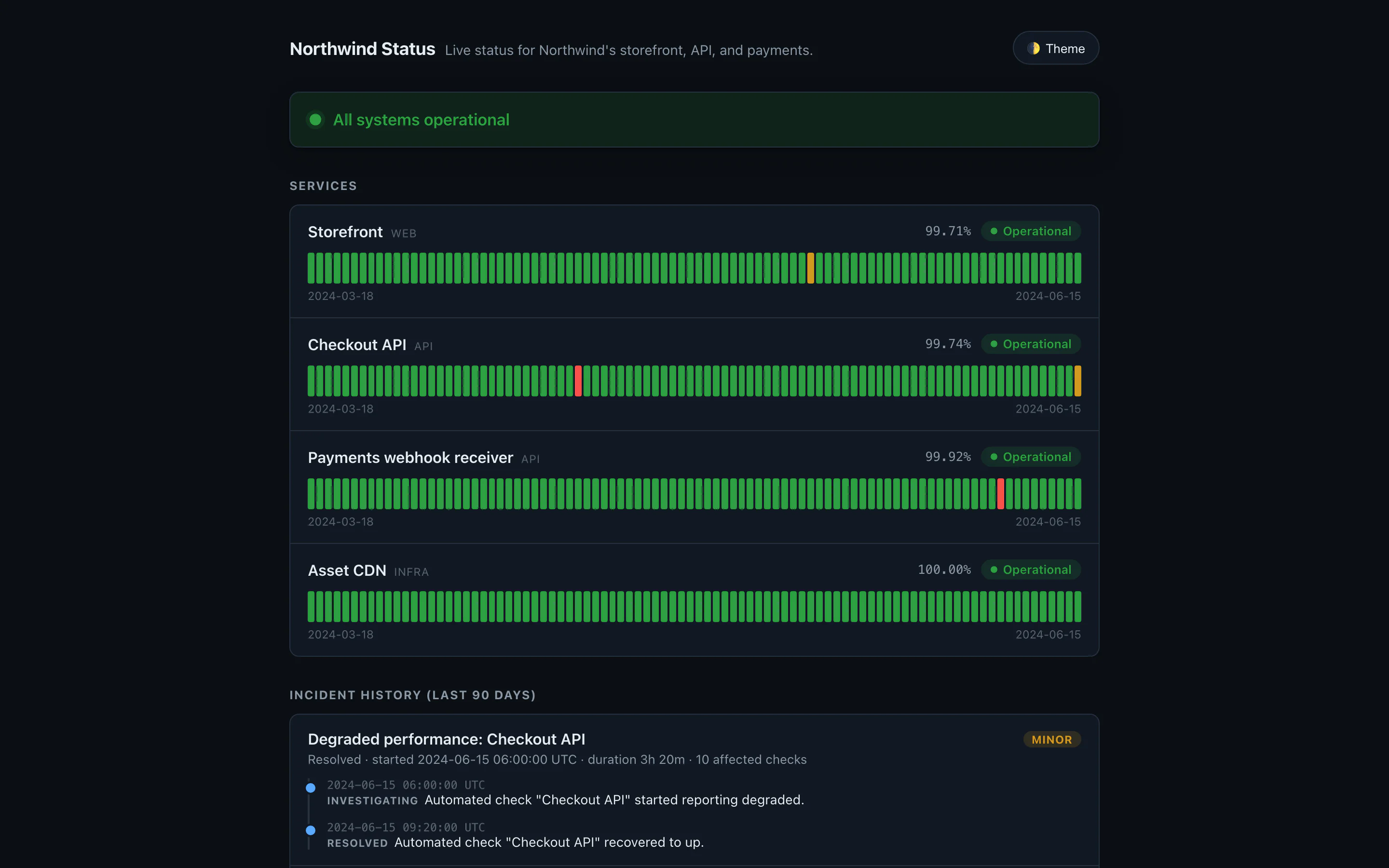
A TypeScript CLI that runs HTTP checks with assertions, appends every observation to a JSONL log, derives incidents from consecutive bad runs, and generates a static dark/light page from that history alone. There is no admin switch for “operational”; missing or stale data is never shown as green.
- Config to Checker
- Checker to results.jsonl
- results.jsonl to buildSiteData
- incidents.json to buildSiteData
- buildSiteData to Static site
03/Implementation
- 01A checker calls each endpoint on a schedule and evaluates assertions: status code or range, latency thresholds, body text or regex, JSON paths and headers.
- 02Every observation, pass or fail, is appended, never edited, to a JSONL file that serves as the audit trail and can be replayed through the generator.
- 03Incidents are derived from runs of consecutive degraded or down results; a postmortem overlay can add a title and text but cannot invent an incident.
- 04The generator is a pure function from config, results and overlay to a static index.html, CSS and theme script, plus a data.json audit snapshot.
04/Engineering
Only latency can be “degraded”
A failing non-latency assertion is always down; latency between the degraded and down thresholds, with everything else passing, is degraded. The rule lives in one file.
Missing and stale data are never green
A service with no results shows “No data yet”, one older than staleAfterMinutes shows “No recent data”, and future-dated or malformed rows are skipped and counted. A dedicated regression suite enforces this.
Pure, synchronous generation
buildSiteData takes hand-built result arrays in tests, so page output is reproducible without running real HTTP checks.
05/Interface
Real screenshots of the running software. Captions state the data shown.
06/Tech stack
- TypeScript
- Node.js 20+
- Commander
- Zod
- Vitest
- ESLint
- GitHub Actions
07/Result
Verified outcomes
- 145 Vitest tests and strict type-checking, run by CI on Ubuntu, Windows and macOS together with lint, build and a full demo-site build (per the README).
- The README screenshots are the output of a seeded, deterministic demo fixture checked into the repository.
Known limitations
- Not published to npm; it runs from a clone.
- Checks are HTTP only.
08/Links
Related work
Versioned system-design workspace
ArchitectFlow →
Design a system's architecture, data model, API and UI as one versioned document, check it with deterministic rules, and generate an implementation prompt from the exact saved revision.
Open source · Experimental
Serverless threat detection
Serverless Log Monitoring & Threat Alert System →
A security-focused serverless endpoint that turns raw log lines into incidents, evidence and alerts.
Open source · Prototype
Market tracker
Puffer →
A full-stack stock tracker with watchlists, market search and AI-written news digests delivered by background jobs.
Open source · In development
Next case study
ModelHarbor →